The LIFE approach in depth
What LIFE consists of and what it builds on. LIFE supports educators and school leaders in finding meaning and purpose in their personal and professional lives, so that they can help children and young people flourish.
A journey that starts with the person
LIFE is a personal development journey for teachers, school leaders and student teachers. It invites them to step back from the pace of daily work and explore, together with others, their own sense of meaning and purpose in life.
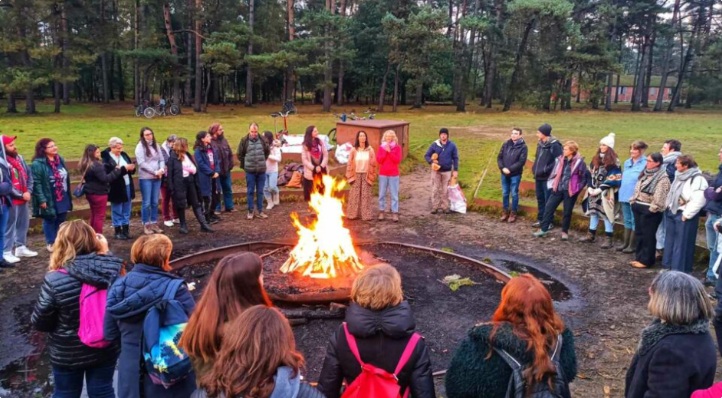
The journey unfolds over several months. Participants explore a series of fundamental life questions through short texts from many traditions, dialogue, listening, personal reflection, creative practice and shared rituals, often in places away from everyday routines and close to nature. All of this takes place in a small learning community that is deliberately built and cared for, where everyone has a voice and no one is handed the answers.
LIFE does not treat personal and professional development as separate tracks. When educators come to see themselves and their lives more clearly, this changes how they relate to others, how they teach and how they lead. The professional changes because the person has changed.
What LIFE brings to educators and school leaders
In your personal life, LIFE offers time and space to reflect on what really matters to you. Participants describe a stronger sense of meaning and purpose, renewed energy, and the experience of being truly listened to. Many find in the group a lasting circle of colleagues who understand the joys and weight of working in education.
"I felt more alive! Or rather being reminded of how it feels! I appreciated having the chance to get out of my regular life for a moment and have space to reconnect with parts of me I have missed for a while." (A LIFE participant)
In your professional life, LIFE gives you new ways of working with children, young people and colleagues. You learn to open real dialogue, to listen without judging, and to create spaces where difficult questions can be explored safely. You experience the methods yourself before you use them, so you can adapt them to your own learners and your school.
"Listen to children, see them as they are, give them space and time, let them experience themselves." (A LIFE participant)
For children and young people, the change in the educator becomes a change in the classroom. When educators bring wonder, listening and shared inquiry into their daily work, children and young people learn to think together, care for others and discover what makes their own lives meaningful. This reflects a growing shift in education, including recent OECD work on education for human flourishing, towards helping children and young people live meaningful lives, not only reach good results.
The foundations of LIFE
LIFE rests on three foundations that support each other: philosophy, transformative learning and human flourishing.
Explore the foundations
Philosophy gives LIFE its central practice: examining our own lives together, through questions and dialogue. This practice goes back to Socrates, for whom the unexamined life was not worth living, and who taught by asking questions rather than giving answers. LIFE also draws on Plato's view of education as a turning of the whole person, not only the mind, and on Aristotle's understanding of the good life as an active way of living well, built through practice and guided by practical wisdom. Listening and shared inquiry complete this foundation.
Transformative learning explains how this examination can change the way we see ourselves and the world, and how we live. Jack Mezirow described how adults come to question the deep assumptions that shape their thinking, feeling and acting, through critical reflection and open dialogue with others . Later thinkers widened this understanding. Transformation also happens through emotion, imagination and image (Dirkx, 1998), through dialogue in community and in relation to real life (Freire, 1970/2000), and through the meeting of thought, feeling and relationship (Illeris, 2009). LIFE brings these strands together and works with the whole person.
Human flourishing gives LIFE its aim. Following Aristotle, flourishing is not a passing feeling of happiness but a way of living well with others over a whole life (Aristotle, Nicomachean Ethics, Book I). In education, flourishing is returning as the deepest aim of learning, beyond skills and results (Kristjánsson, 2016, 2019). LIFE begins with the flourishing of educators and school leaders, because they can only help children and young people flourish when their own sense of meaning and purpose is alive.
The LIFE Teacher Academy deepens these foundations, building on the original LIFE project (LIFE Partners, 2024; LIFE Teacher Academy, 2026).
How transformation happens in a LIFE session
Every LIFE session follows the movement of transformative learning: from a question that unsettles us, through reflection and dialogue, to new ways of seeing and acting.
Meeting a question
Each session opens with a life question that has no easy answer, and with texts from different traditions that see it in very different ways.
Looking inward
Through silent reading, journaling and guided reflection, participants connect the question to their own lives, their experiences and their feelings.
Questioning our assumptions
Participants ask of each text: "If this were true, what would have to change in my life?" Beliefs we usually take for granted become open to question.
Realising we are not alone
In dialogue and careful listening, participants discover that others struggle with the same questions. The group becomes a safe learning community.
Trying new ways of acting
Participants imagine how they might live and work differently, for example by writing a letter to their future self or creating a vision board.
Bringing it into our lives
Each session ends with reflection, individually and in the group. In the closing session of the journey, each participant shares their vision of a flourishing life.
Transformation does not usually happen in one moment. In LIFE it grows step by step, over months, as each question builds on the last and the group grows into a community.
The pillars and methods of LIFE
In practice, LIFE rests on three pillars that every session brings together: Socratic dialogue, active listening and transformative learning.
Explore the LIFE pillars and methods
Three pillars
Socratic dialogue: thinking together about real questions, where no one hands down the answer. The facilitator, like Socrates, helps ideas emerge rather than teaching them.
Active listening: listening to understand, not to reply or give advice. Being truly heard is often what makes it possible to look honestly at ourselves.
Transformative learning: reflection that changes not only what we think, but how we see ourselves and how we live.
The three depend on each other. Dialogue without listening becomes debate. Listening without inquiry offers support but does not move our thinking. And both, without reflection that changes how we live, remain a good conversation that leaves life as it was.
The methods
LIFE is not a fixed script. Facilitators adapt each session to their group, using a shared set of methods tested in several European countries:
- Texts from many traditions: short philosophical, religious, literary and poetic texts that offer different answers to the same question.
- Dialogue in pairs and groups: paired reading, community of inquiry, silent conversation and fishbowl dialogue.
- Sharing and reflection: story-sharing without advice or judgement, journaling and guided reflection.
- Creative and embodied practices: art, collage, music, movement, writing and walks in nature.
- Rituals and place: shared moments that open, hold and close the group, often away from daily routines and close to nature.
The facilitator
A LIFE facilitator is a fellow inquirer, not an expert with the answers. They create a space where everyone has a voice, feels safe to share and can listen without judgement, and they reflect honestly on their own values too. Every session ends with reflection on the methods as well as the experience, so participants learn LIFE from the inside: they experience it first, and then learn how to offer it to children, young people and colleagues.